
Columbus runs one of Georgia's longest humid cooling seasons, so indoor humidity - not a leak - is the usual cause. Below: how to tell one from the other, what has to be removed, and why dry wood also deters termites here.
For every price on one page, read the mold removal cost in Columbus guide: what each job class runs, what moves an estimate, and what a written quote should show.
How do I know if I have a problem?
A smell that comes back after cleaning, allergies that ease when you leave the house, a patch that keeps returning on the same wall. These are the signs people describe most often, and they usually point at moisture rather than at the growth itself.
How do I know if I have a mold problem?
Visible spots, a musty smell that persists, allergy symptoms that ease away from home, or any water event in the last few months. Smell without visible growth usually means cavity growth: exactly what inspections locate.
Will insurance cover my mold or water damage?
Sudden events usually have the best claims; gradual leaks usually don't, and mold caps vary by policy. Either way, ask for documentation in adjuster-ready form, because claims run on documentation.
How fast should active water be handled?
Call quickly: growth can establish on wet materials within 24-72 hours, and early dry-out is the cheapest remediation there is.
What does mold removal cost in Columbus, and why do quotes differ?
What removal costs depends on the affected area, and what keeps it gone depends on correcting the moisture, which is why a fair quote prices the pair.
What does mold removal cost here?
Small contained areas $500-$1,500; typical remediation $1,500-$9,000 by extent and materials; inspections $200-$600. Every range should become a written number after an inspection with moisture readings.
What happens if I go ahead?
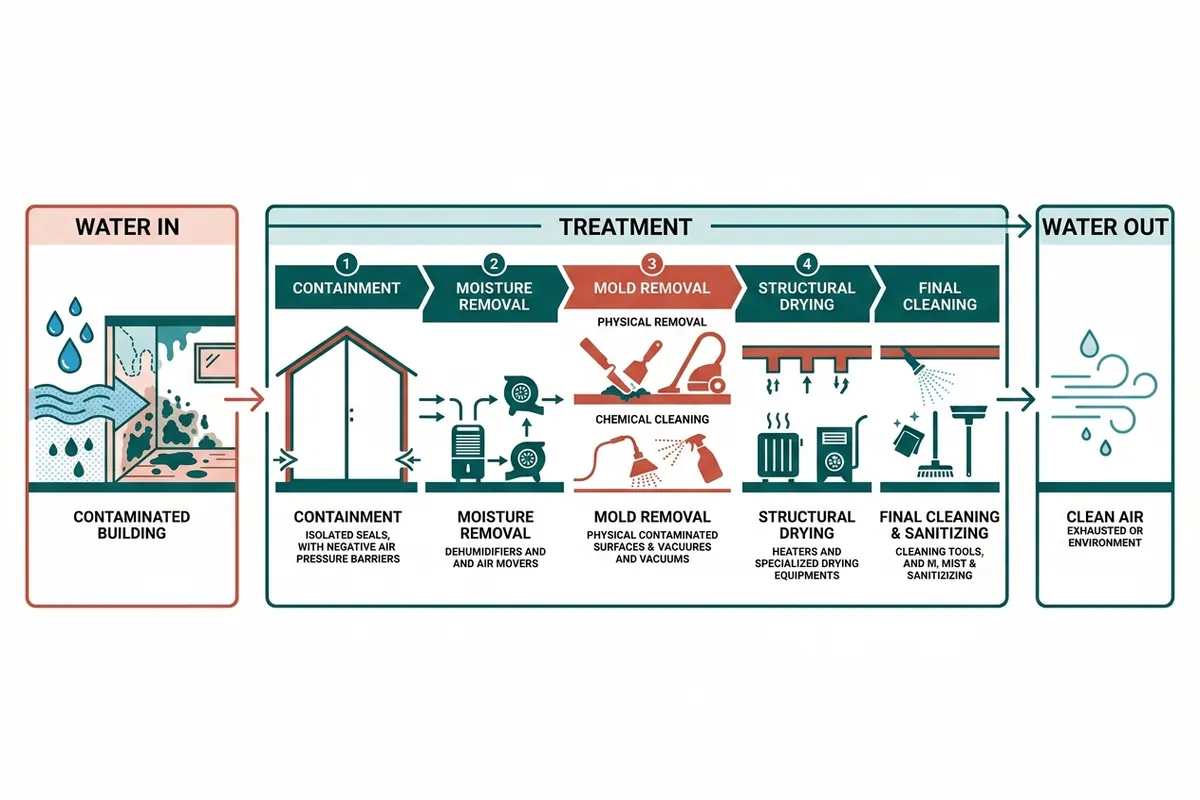
What the work involves, how long you need to be out, and what verification looks like afterwards.
How serious is mold in the Columbus area?
The climate makes it a when-not-if problem: 47-48 inches of rain a year and one of Georgia's longest humid seasons keep every building fighting moisture most of the year. Caught small, it's a contained fix; ignored through a humid season, it compounds.
Should the job fix the moisture or just remove the mold?
Both, always. Removal without the moisture correction is a subscription in this climate, so ask for a scope that names the cause and prices its fix.
When is professional remediation required?
EPA's practical threshold is about 10 square feet of growth: beyond that, professional containment and removal is recommended. Below it, a good specialist will tell you honestly when it's DIY-sized.
Is black mold an emergency?
Color doesn't set danger: CDC treats all indoor mold the same. A heavy black bloom usually signals a long-running moisture problem, and that deserves urgency for the water's sake, not the color's.
The pattern behind every answer
Reading back through these, one theme repeats: evidence beats fear. This metro's climate makes mold common enough that scare-selling works on somebody every day, which is exactly why measured findings, EPA thresholds, and written scopes matter more here than in gentler climates. Whatever your situation, the sequence is the same: look, measure, photograph, then price.
Didn't find your question?
Ask directly or book an inspection and ask everything while the readings come in.
Book a Columbus mold inspection
Tell us what you're seeing, whether spots on a wall, a musty room or a leak that got away, and we'll pass it to one independent local specialist, who can set up an inspection with moisture readings. If water is coming in right now, call (762) 309-1710.